Oliver Page
Case study
December 10, 2025
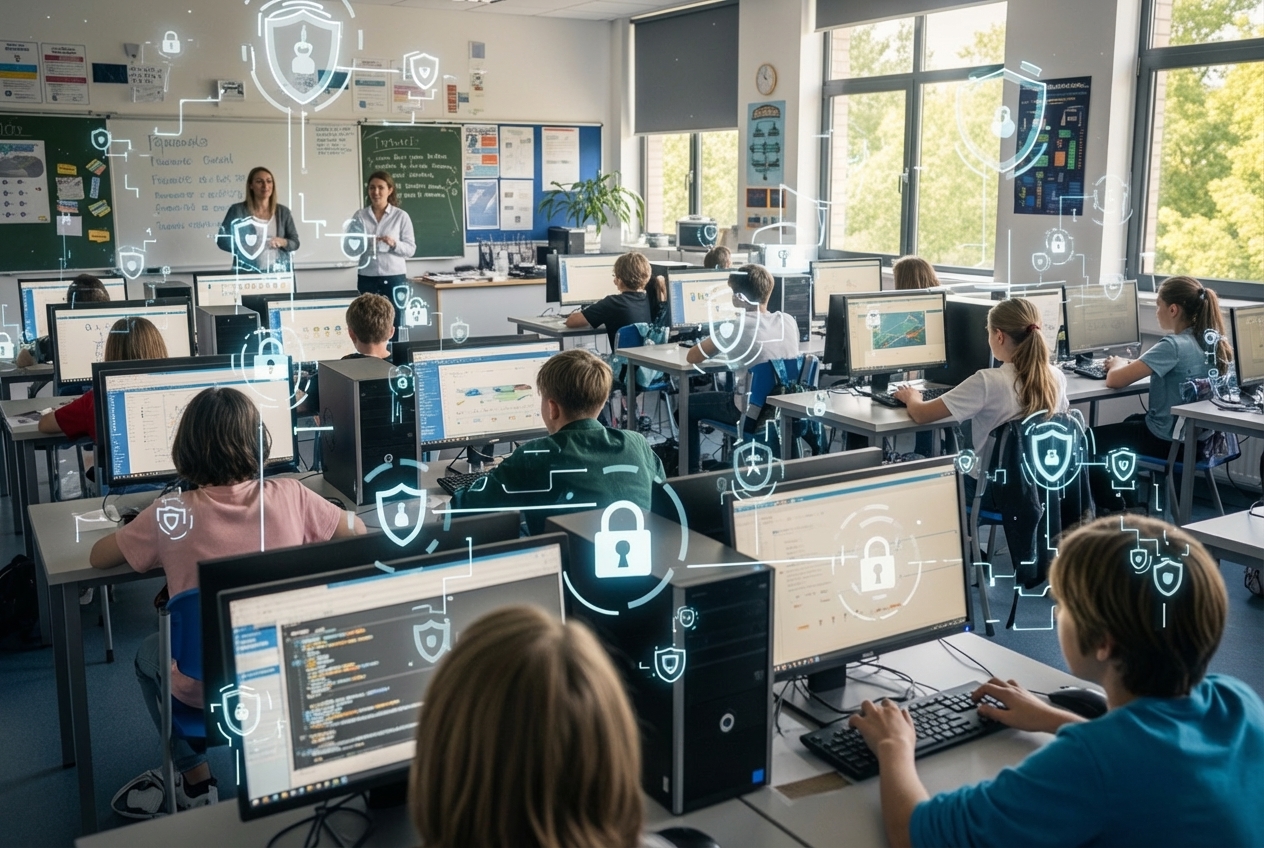
Why schools struggle to prove cybersecurity ROI is a question keeping IT directors awake at night. Here's the quick answer:
Schools face unique challenges in demonstrating cybersecurity return on investment because:
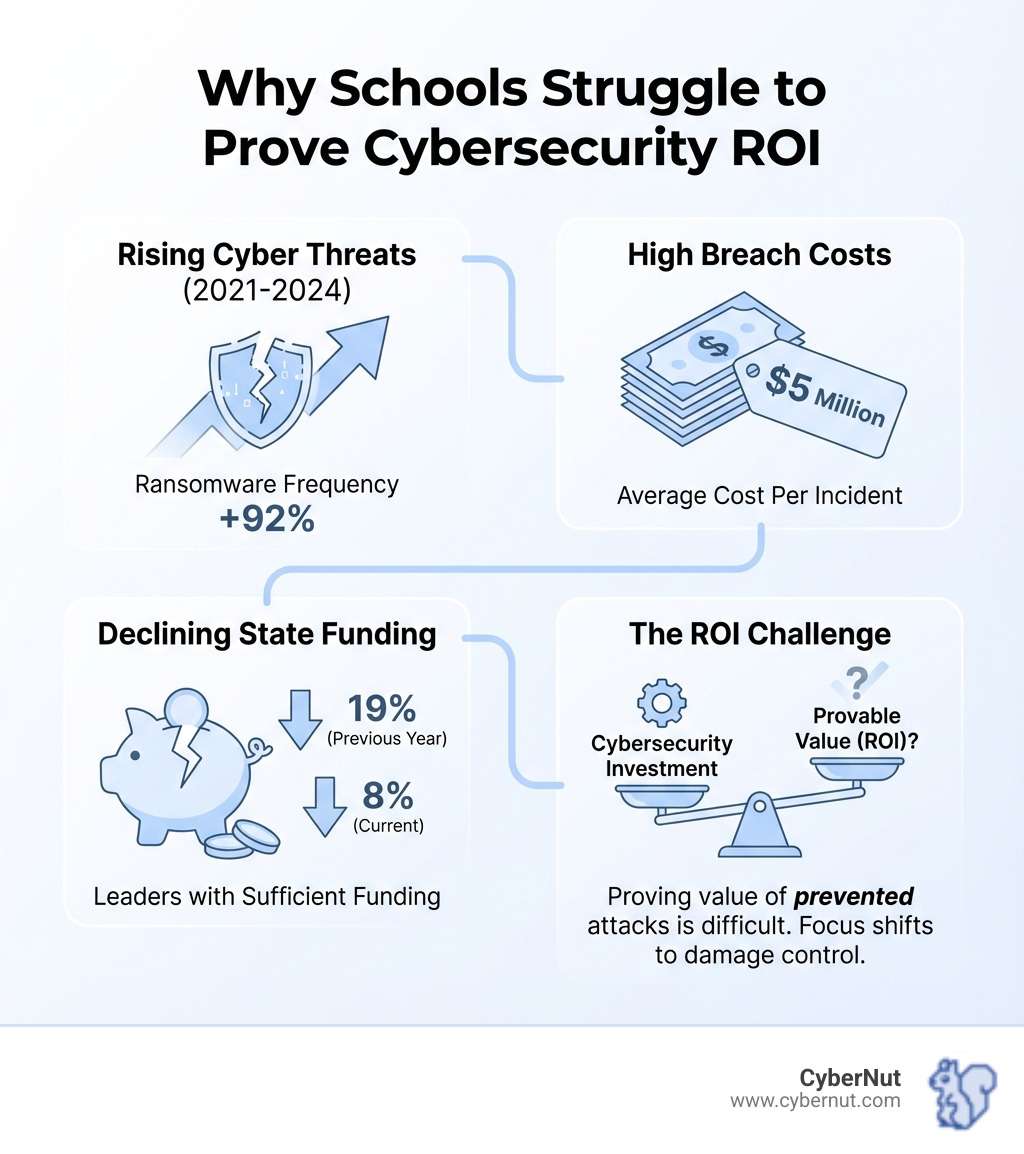
The numbers tell a stark story. Cybersecurity Ventures predicts that the annual financial toll of cybercrime could reach $10.5 trillion by 2025. Educational institutions face a 35% increase in attacks between 2023 and 2024. Yet the percentage of state leaders who believe their state provides "sufficient" funds to support cybersecurity efforts in schools dropped from 19% to just 8% in a single year.
Meanwhile, your district is dealing with a reality that would seem absurd if it weren't so dangerous: on average, there is more than one cybersecurity incident per school day in K-12 education. Ransomware attacks on schools jumped 92% between 2022 and 2023.
The cruel irony is that schools are prime targets, holding treasure troves of sensitive data like student records and Social Security numbers. Yet, unlike businesses, they can't point to revenue gains from security investments. They must justify spending to prevent bad outcomes, forcing them to prove the value of an attack that never happened.
The challenge goes beyond math. When a school board debates funding, they're choosing between hiring teachers, fixing leaky roofs, or investing in invisible digital protection. The cybersecurity investment only becomes visible when it fails - when classes are canceled, when student data is stolen, when the district makes headlines for all the wrong reasons.
This isn't just about balance sheets. With 82% of K-12 schools reporting a cyber incident, the real costs are disrupted learning, compromised student safety, and shattered community trust. Children's data is exposed, creating a "lifetime exploitation package" for criminals, because security budgets lose out to more visible needs.
Explore more about Why Schools Struggle to Prove Cybersecurity ROI:

In cybersecurity, the goal is to ensure nothing gets broken. This creates a core dilemma: how do you calculate the return on investment for a problem that was prevented from ever occurring? This is central to why schools struggle to prove cybersecurity ROI.
Cybersecurity is fundamentally a cost center, not a revenue generator. Its primary function is loss prevention – safeguarding assets, maintaining trust, and ensuring continuous operations. For businesses, the ROI of cybersecurity might be framed in terms of avoiding potential financial losses. But for schools, the "assets" are student data, learning continuity, and community reputation, which don't easily translate into profit-and-loss statements.
The benefits of robust cybersecurity are often intangible. How do you put a dollar value on a student's uninterrupted learning experience? Or the peace of mind parents have knowing their child's sensitive information is secure? As noted in Forbes, cybersecurity is a strategic imperative. However, convincing stakeholders accustomed to direct financial returns is a monumental task.
Even methodologies like Annualized Loss Expectancy (ALE) fall short in the educational context. ALE requires reliable data on incident frequency and cost, which is difficult to gather for averted threats. The data is often scarce and the threat landscape changes too rapidly, making the concept of security ROI feel more like fiction than fact.
So, how do we justify investments in something designed to prevent an invisible "what if"? It's a communication challenge as much as a financial one. We need to help stakeholders understand that preventative measures are not just expenses, but essential safeguards that preserve the educational mission.
Proving cybersecurity's value is like trying to count the fires a fire extinguisher didn't have to put out. A prevented attack goes unnoticed by anyone outside the IT team. There are no headlines or disrupted classes—just business as usual.
This is why schools struggle to prove cybersecurity ROI in a tangible way. Prevented attacks lead to avoided costs, but these are hypothetical scenarios. We can estimate what might have happened – the cost of a ransomware payment or data recovery. But these are projections, not concrete numbers for a traditional ROI formula.
The difficulty lies in attribution. If we implement a new security solution and don't experience a breach, how do we definitively say that the solution was the sole reason? Without hard data on "what didn't happen," it's incredibly hard to attribute success and quantify the unquantifiable. This makes it challenging to present a clear financial case to a school board already struggling with tight budgets.
While the financial costs of a cyberattack are substantial, they represent only a fraction of the true impact. The non-financial impacts are often far more devastating and even harder to quantify, further exacerbating the difficulty in proving ROI.
The non-financial impacts are often more devastating. Consider student safety: exposed data, including intervention plans and social-emotional profiles, becomes a roadmap for scams. A breach can expose a child's entire record, creating what experts call a "lifetime of identity theft and manipulation." This is a profound violation with lasting consequences, not just a financial hit.
A data breach shatters community trust. Parents who believe their children's safety and privacy are paramount may lose faith, leading to anxiety and potential enrollment declines. It's impossible to assign a monetary value to a community's trust in its schools.
Educational continuity is also at stake. Ransomware attacks have forced school districts to cancel classes for days, disrupting learning and causing immense logistical headaches for families. The Chambersburg Area School District in Pennsylvania, for example, canceled classes for three days due to a ransomware attack. This disruption's impact on student progress and family stability is undeniable, even if it doesn't appear on a balance sheet.
Then there's the psychological toll on families and staff and the potential for teacher morale to plummet. These are the hidden costs that make the traditional ROI equation insufficient for capturing the full value of cybersecurity in education.
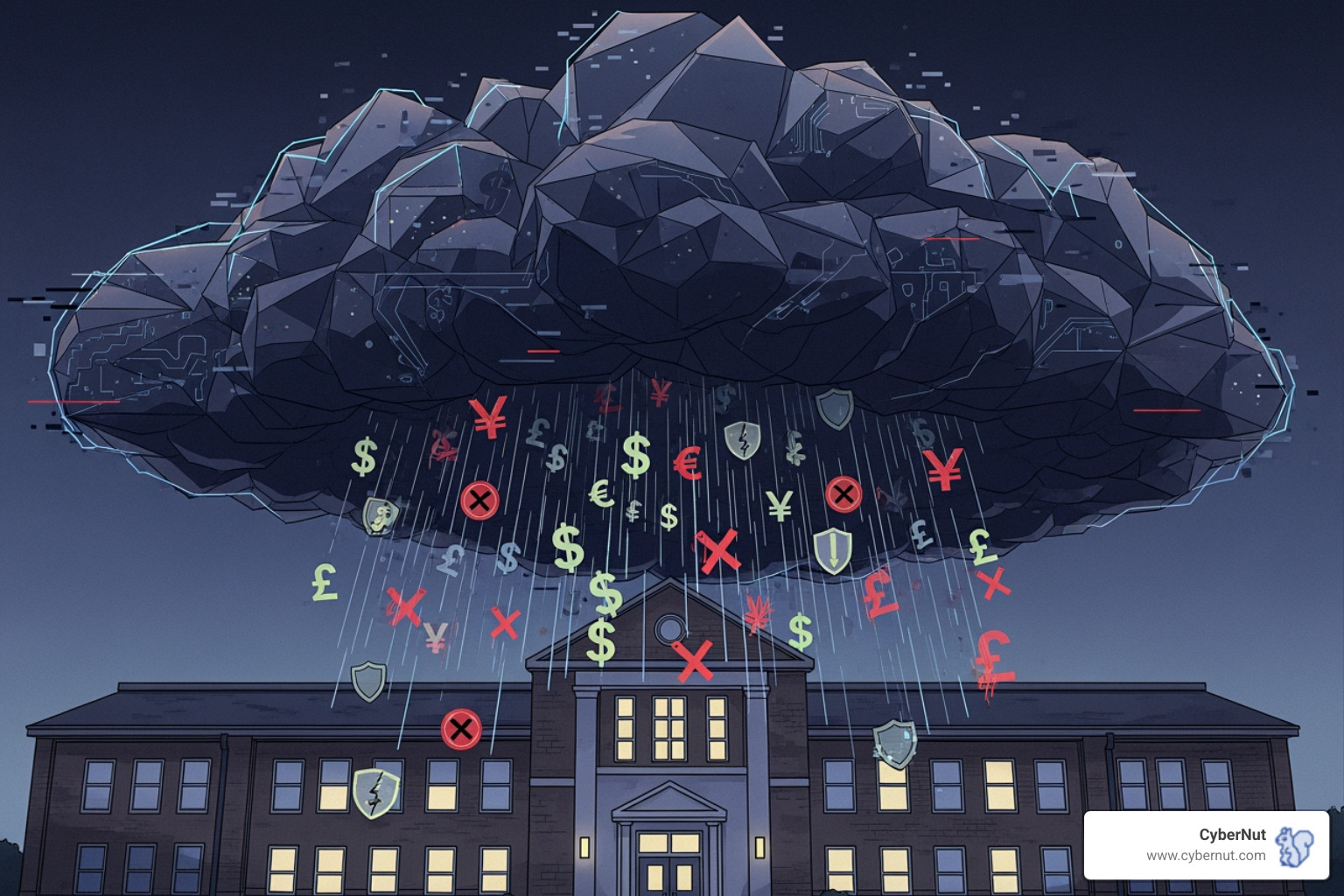
When defenses fail, the consequences are severe and far-reaching. The idea that schools can't afford robust cybersecurity is overshadowed by the reality that they can't afford a breach. The costs ripple through the community for years, making prevention a bargain.
According to IBM Security, the average cost of a school breach is nearly $5 million. This staggering figure highlights the immense financial burden placed on institutions ill-prepared for cyberattacks. It's a cruel twist that the very institutions struggling to justify preventative spending often face catastrophic costs when those preventative measures are absent.
Once a breach is finded, the financial fallout is immediate. Ransomware attacks are especially costly, averaging $2.73 million for educational institutions—$300,000 more than the next highest sector. This figure often includes costs for ransom payments, which some schools feel compelled to pay; system remediation and recovery to clean and rebuild infrastructure; and forensic investigations to determine the extent of the damage. Other expenses include providing credit monitoring services for affected individuals, hiring public relations firms to manage reputational fallout, paying legal fees and regulatory fines for non-compliance, and covering overtime for IT staff working to resolve the incident.
The MGM Resorts ransomware attack, which cost over $100 million, is a stark reminder of how quickly these figures escalate, even for well-resourced organizations. These are the unavoidable costs that make why schools struggle to prove cybersecurity ROI seem like a secondary concern when an attack actually happens.
Beyond the immediate financial hit, cyberattacks inflict long-term costs that drain resources and trust for years.
One significant impact is the erosion of public trust, which can lead to a loss of enrollment. If parents perceive a school district as unable to protect their children's data, they may seek alternatives.
Another tangible long-term cost is skyrocketing cyber liability premiums. As 59% of districts are already reporting, insurance providers are raising rates significantly, or even refusing coverage, for institutions deemed high-risk.
The most concerning long-term cost is the damage to student futures. When a child's sensitive data is exposed, it creates a lifetime risk of identity theft and manipulation. Deutsche Telekom's "Message from Ella" campaign chillingly illustrated how AI-driven deepfakes can be created from a child's data, a risk that caused two-thirds of surveyed parents to alter their data-sharing habits.
These are not merely financial figures; they represent a fundamental disruption to the educational ecosystem. The difficulty in quantifying these systemic costs is a major factor in why schools struggle to prove cybersecurity ROI effectively, as the true value of prevention extends far beyond a simple cost-benefit analysis.
School cybersecurity is a perfect storm of budget constraints, limited resources, overburdened staff, and increasing threat sophistication. These elements all contribute to why schools struggle to prove cybersecurity ROI.
Educational institutions are unique targets. They are entrusted with vast amounts of sensitive data—student records, financial information, and health data. Yet, they often operate with budgets and staffing levels that pale in comparison to private sector entities holding similar data. This inherent disparity creates a critical vulnerability.
The perennial funding crisis is perhaps the most significant challenge. With perpetually stretched budgets, cybersecurity often loses out to more visible needs.
With over 30 states facing K-12 funding shortages by 2023, districts are in a financial bind. The perception of adequate funding has plummeted, with only 8% of state leaders believing their state provides "sufficient" cybersecurity funds, down from 19% the previous year. This reflects a growing awareness that current funding is grossly insufficient.
While there's a new FCC pilot project offering up to $13.60 per student annually, a total of $200 million over three years, this is a drop in the ocean compared to the scale of the problem. When a single breach can cost nearly $5 million, the available funding is often too little, too late. Schools are constantly being asked to "do more with less," which in cybersecurity often means making unacceptable compromises.
While technology is important, the human element is often the weakest link. According to an IBM report, human error is a factor in the vast majority of cyber attacks, from clicking malicious links to falling for social engineering.
This challenge is amplified in schools due to a diverse user base of students, teachers, and parents with varying technical literacy. Students, in particular, may prioritize convenience over security, making them susceptible to clicking suspicious links or downloading unsafe software.
Ransomware attacks on K-12 schools increased 92% between 2022 and 2023, with phishing often being the initial vector. This highlights the critical need for effective cybersecurity training for all users. However, providing constant training that resonates with such a varied audience is a significant undertaking. When training budgets are tight, it's easy for this crucial preventative measure to be overlooked. Yet, investing in human firewalls through engaging training is one of the most effective ways to reduce risk.
Navigating the labyrinth of regulatory compliance, like FERPA and COPPA, adds another layer of complexity. Schools must adhere to strict regulations on student data privacy, which contributes to why schools struggle to prove cybersecurity ROI.
The Family Educational Rights and Privacy Act (FERPA) and the Children's Online Privacy Protection Act (COPPA) are not static; regulators are actively reexamining them, calling for stronger technical standards. States are also clarifying that districts, not just their vendors, carry ultimate responsibility for privacy breaches.
Meeting these requirements demands specific security measures and data governance. While compliance is non-negotiable, its direct financial ROI is hard to prove. It's an expense to avoid fines, not generate revenue. The value is in risk avoidance, which is hard to quantify. The burden of auditing and reporting also strains limited IT resources.
Given the difficulty of proving ROI, the narrative must shift to risk reduction and resilience. This approach better aligns with cybersecurity's true value: safeguarding the school's core mission and ensuring operational continuity.
Frameworks like risk management and business continuity offer a better way to communicate value. They allow us to speak to stakeholder priorities—student safety, uninterrupted learning, and community trust—by showing how cybersecurity helps the school fulfill its purpose without disruption.
A strong business case for cybersecurity centers on continuity and trust. Effective security minimizes downtime and ensures continuous learning. A ransomware attack can lock down systems, and the cost is measured in lost learning hours and administrative chaos. Investing in cybersecurity is an investment in keeping the school running.
Furthermore, robust cybersecurity protects the school's brand and reputation. In an era where data breaches are common news, schools that can demonstrate due diligence and a commitment to protecting sensitive information build and maintain trust with parents and taxpayers. This trust is invaluable, influencing enrollment, community support, and overall institutional standing.
We believe that a strong cybersecurity posture is foundational to every school's success. More info about our platform can provide insights into how we support this essential need.
Since traditional ROI is a poor fit, we need alternative metrics that effectively demonstrate value in terms of risk mitigation and operational stability. For example, you can measure the risk reduction percentage to show how much the overall cyber risk profile has decreased. A compliance adherence score can demonstrate that investments are successfully meeting legal obligations and avoiding potential fines. Key performance indicators like Mean Time to Detect (MTTD) and Mean Time to Respond (MTTR) measure how quickly an organization can identify and contain a threat, with lower times indicating a more resilient security posture. Tracking the reduction in successful phishing attempts directly demonstrates the effectiveness of security awareness training, while monitoring the number of critical vulnerabilities patched shows a proactive approach to reducing the attack surface.
These metrics offer a more compelling picture of the value generated by cybersecurity investments, helping to answer why schools struggle to prove cybersecurity ROI by providing a new lens through which to evaluate success.
Communicating cybersecurity's value to the school board and taxpayers requires storytelling with data, focusing on what matters most to the community, not abstract technical jargon.
Instead of just presenting budget figures, use breach case studies to illustrate the devastating consequences of underinvestment. Discussing how the Chambersburg Area School District canceled classes for three days due to a ransomware attack paints a vivid picture of potential disruption. This approach makes the invisible threat tangible.
The conversation must center on student safety and privacy. Frame cybersecurity as a critical component of a safe learning environment, just as vital as secure buildings. Highlight how proactive measures prevent identity theft and protect sensitive data.
Aligning security initiatives with the school's core educational mission is also crucial. Explain how robust cybersecurity supports digital learning initiatives and ensures that technology improves, rather than hinders, education. Implementing modern security architectures like zero trust can be presented not just as a technical upgrade, but as a strategic move to safeguard the future of learning.
By focusing on these compelling narratives, we can effectively bridge the gap in understanding and secure the necessary support for these vital investments.
For school leaders and IT professionals seeking a more in-depth understanding of the challenges and solutions surrounding cybersecurity investments in education, we've developed a comprehensive white paper. This resource dives deep into the complexities of why schools struggle to prove cybersecurity ROI, offering detailed analysis and actionable recommendations custom specifically for K-12 institutions.
Our white paper explores key findings on the true cost of breaches, the limitations of traditional ROI models, and the alternative frameworks that can effectively justify cybersecurity spending. It provides practical strategies for identifying vulnerabilities, implementing effective security measures, and communicating their value to all stakeholders.
We believe this resource is essential for any school striving to build a resilient and secure learning environment. To access the full white paper and gain valuable insights to protect your school, simply click the link below.
The persistent struggle to measure cybersecurity ROI in schools often distracts from the real goal: building a truly resilient educational environment. When we fixate on traditional financial returns, we miss the broader, more critical benefits of protecting our students, staff, and operations. Cybersecurity in education is not about generating profit; it's about preventing catastrophe, maintaining trust, and ensuring the continuity of learning.
The future of school cybersecurity lies in a proactive, rather than reactive, approach. It means understanding that investment in security is an investment in the school's fundamental ability to function. And crucially, it means investing in people – fostering a culture of security where every individual, from the superintendent to the newest student, understands their role in protecting the digital ecosystem.
At CyberNut, we understand these unique challenges. Our cybersecurity training for K-12 schools focuses on phishing awareness through automated, gamified micro-trainings. Our custom, low-touch, and engaging approach is designed specifically for educational institutions to improve cybersecurity resilience, addressing the human element that accounts for 95% of cyberattacks. We empower your staff and students to become your strongest defense, turning a common vulnerability into a powerful asset.
Don't let the complexity of traditional ROI calculations prevent your school from achieving the resilience it needs. Take the first step towards a more secure and trusted future.
Oliver Page
Some more Insights


Back
.png)
.png)

.png)
.png)
.png)
.png)