Oliver Page
Case study
November 21, 2025
The Cost of Delay: What Happens When Schools Postpone Cybersecurity Investments is a compounding liability affecting everything from student learning to district finances and community trust. Postponing these investments exposes schools to:
K-12 schools have become prime targets for cybercriminals, with nearly 1,400 publicly reported cyberattacks in schools in 2021—almost double the number from 2019. The September 2022 ransomware attack on Los Angeles Unified School District is a stark warning. After leaders refused to pay, hackers released 500 GB of sensitive data, including student psychological evaluations and Social Security numbers, shattering family trust.
The true cost of delay extends far beyond ransom payments or data breach headlines. Schools face hidden costs that compound over time: lost learning days, teacher burnout, skyrocketing insurance premiums, and a damaged reputation. Meanwhile, attacks on K-12 schools grew by 275% in 2023, as criminals target them for their limited budgets and lack of expertise.
The average school spends less than 8% of its IT budget on cybersecurity, with one in five spending less than 1%. This chronic underinvestment creates a "security debt" that grows more expensive to address daily, especially as AI-powered attacks become more sophisticated.
Every postponed upgrade, delayed training, and unfilled IT position accumulates risk. When an incident strikes, schools pay that debt at emergency rates—with interest.
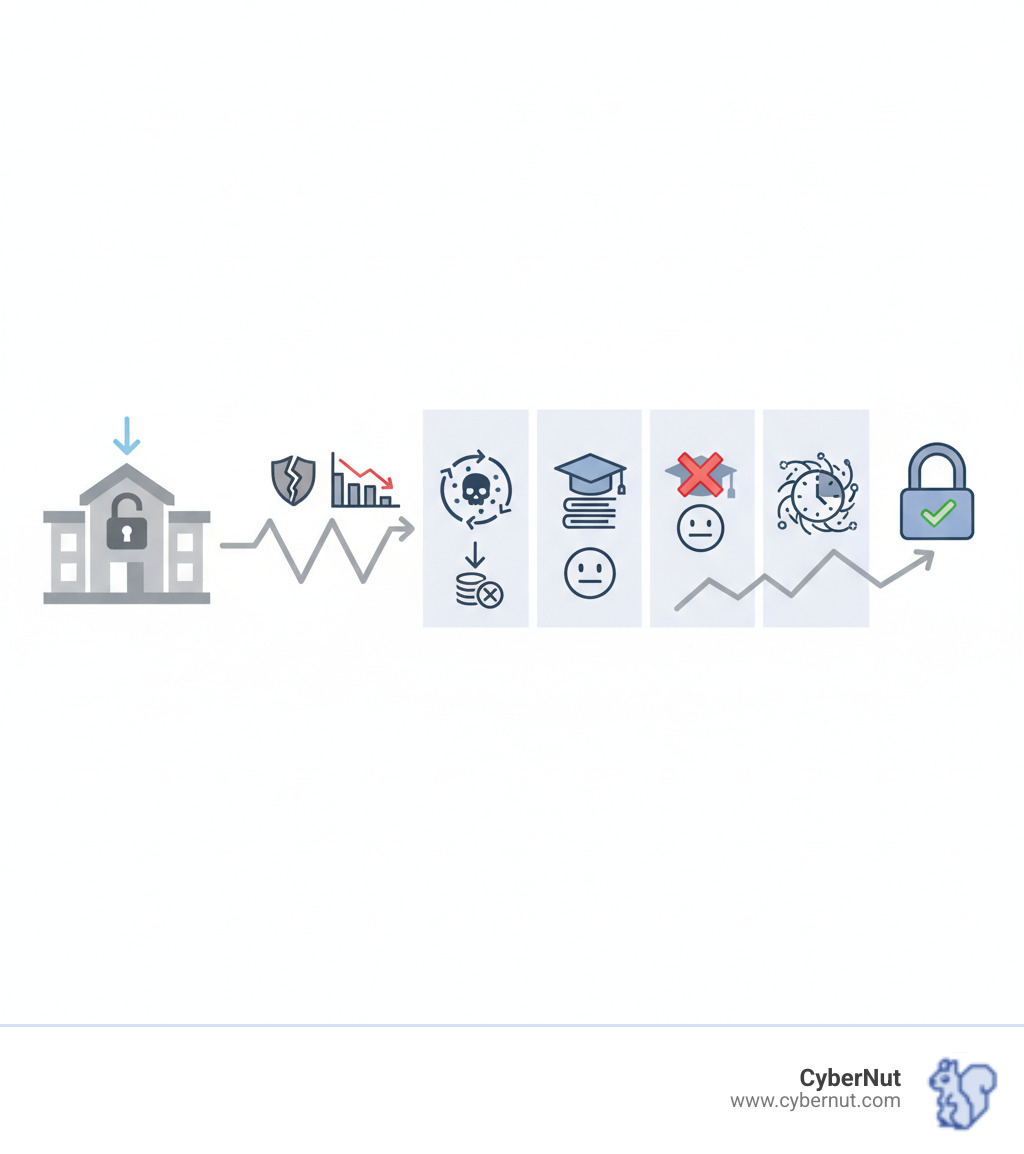
Why do K-12 schools, facing constant cyber threats, often delay crucial cybersecurity investments? The answer lies in the "budget bottleneck," where immediate needs often overshadow proactive security.
One of the biggest problems is limited budgets and competing priorities. Schools stretch every dollar to cover teacher salaries, textbooks, and building repairs. Cybersecurity, though vital, is often treated as an "overhead expense" rather than a foundational need. This challenge will intensify with the looming "Fiscal Cliff" in 2026, when federal pandemic relief funds disappear, forcing even tougher choices that push cybersecurity down the list.
Beyond the cash crunch, complex grant bureaucracy and procurement red tape slow down security initiatives. It can take months or even years to get a solution in place, a pace that can't match fast-moving cyber threats.
Then there’s the human factor. Many districts suffer from a lack of in-house IT expertise, as school salaries struggle to compete with the private sector. This staffing gap often leads to an underestimation of risk. Without dedicated experts, school leaders may not fully grasp the severity of potential threats or the long-term consequences of inaction.
The numbers tell a story of neglect. The average school dedicates less than 8% of its IT budget to cybersecurity, while one in five spends less than 1%. This chronic underinvestment creates a massive "security debt" that grows more expensive daily.
This debt represents accumulated vulnerabilities. Many schools run legacy systems and have vendor dependencies, making them difficult and expensive to secure. When relying on third-party vendors, schools are often stuck waiting for them to patch security issues. Compounding this, nearly 40% of K-12 schools lack a basic cybersecurity response plan, and 81% haven't fully implemented Multi-Factor Authentication (MFA). This means The Cost of Delay: What Happens When Schools Postpone Cybersecurity Investments is a real and present danger.
Perhaps the most dangerous idea is the belief that schools are not valuable targets. Cybercriminals don't discriminate. Schools are treasure troves of sensitive student records, employee data, and health information. They are targeted precisely because they often have weaker defenses. As a GAO report on K-12 cybersecurity noted, some district leaders don’t prioritize cybersecurity funding because they don't see it as a threat—a mindset that creates a self-fulfilling prophecy of vulnerability.
When schools postpone cybersecurity investments, "what if" scenarios become harsh realities. A cyberattack brings chaos, disrupting every part of the school day.

The first impact is an immediate operational shutdown. Computers go dark, networks become unreachable, and digital learning tools disappear. When Las Cruces Public Schools faced a ransomware attack, its network was down for weeks, forcing teachers to use chalkboards and old-school gradebooks. Another district had to revert to paper for lesson plans, attendance, and communications.
This means inaccessible learning platforms (LMS), online textbooks, and other digital resources. Modern teaching grinds to a halt. Disrupted communications prevent staff from collaborating and parents from getting updates. All of this leads to canceled classes and exams, causing serious learning loss and stress. Reverting to paper is an inefficient scramble that highlights our dependence on secure digital tools.
The financial fallout from postponing cybersecurity is shocking, often costing far more than prevention. An attack brings a wave of expenses that can cripple school budgets.
Direct costs include ransom demands (from $5,000 to $40 million), forensic investigation costs, IT recovery and overtime, and hardware replacement. Baltimore County Public Schools racked up $9.7 million in recovery costs, while Buffalo Public Schools spent $10 million. The average cost of a business data breach hit $4.9 million in 2024, as detailed in this report on the average cost of a data breach, hinting at the financial blow schools can expect.
Beyond immediate fixes, schools face regulatory fines for failing to protect data under laws like FERPA and COPPA. Breaches can also lead to pricey legal fees and lawsuits. Worse, rising cyber insurance premiums are a direct result of these attacks, with 59% of districts reporting higher premiums. Underinvesting leads to breaches, which makes insurance more expensive. The Cost of Delay: What Happens When Schools Postpone Cybersecurity Investments is a continuous financial drain.
The human toll of downtime on students and staff is heartbreaking and often overlooked. For students, the impact is huge, starting with significant lost learning time. A GAO report showed learning loss can last up to three weeks, with full recovery taking two to nine months. This disruption causes student anxiety and stress over missed work and an uncertain academic future.
Staff members also carry a heavy load. Teachers face burnout rebuilding lesson plans from scratch, leading to immense pressure and damage to staff morale. The IT team, often already stretched thin, can become the target of a blame culture. The human cost is the emotional toll on the dedicated people educating our children.
Finally, a breach causes an erosion of parent and community trust. A cybersecurity failure shatters the trust parents place in schools, damaging reputations for years. The Los Angeles Unified School District incident, where sensitive student data was released, caused deep distress and a lasting feeling of betrayal, showing that the devastating business impacts of a cyber breach extend far beyond money.
The cybersecurity battle facing K-12 schools is evolving rapidly, with criminal tactics growing more sophisticated. The Cost of Delay: What Happens When Schools Postpone Cybersecurity Investments becomes more severe as threats accelerate faster than many schools can respond.

Today's cybercriminals are organized, well-funded, and professional. The increasing sophistication of attacks means simple firewalls and antivirus software are no longer enough.
One alarming development is Ransomware-as-a-Service (RaaS), where criminal enterprises rent out ransomware tools. This has led to a 275% growth in ransomware attacks targeting K-12 schools in 2023. Modern attacks also employ data exfiltration threats, stealing sensitive information before encrypting it. This gives them double leverage, as they can threaten to release confidential data even if a school has backups.
Schools are also vulnerable due to their reliance on vulnerable third-party vendors for everything from student information systems to food service software. A breach at one vendor can trigger supply chain attacks that cascade across hundreds of districts. Your school's cybersecurity is only as strong as the weakest vendor in your ecosystem. Postponing investments isn't just about protecting internal systems; it's about securing every connection point.
Phishing emails are getting harder to spot thanks to Artificial Intelligence. AI has changed the game, making attacks faster, more convincing, and highly personalized. Today's AI-improved social engineering creates grammatically perfect, contextually appropriate messages that feel authentic.
We now see highly personalized phishing campaigns that reference real events and colleagues. Most concerning are deepfake threats—AI-generated audio or video that can impersonate real people with startling accuracy. Imagine a voicemail that sounds exactly like your superintendent authorizing an emergency payment. These aren't science fiction; they're happening now.
Business Email Compromise (BEC) attacks targeting school administration are particularly effective with AI, leading to fraudulent wire transfers or data releases. As McKinsey notes, AI is both a threat and a defense in cybersecurity today, but criminals are weaponizing these tools faster than many schools can adapt. Postponing training leaves your staff unprepared for threats that grow more sophisticated monthly.
Postponing cybersecurity investments also leads to a complex web of legal and regulatory consequences. When a breach happens, schools must steer a minefield of federal and state regulations.
The Family Educational Rights and Privacy Act (FERPA) protects student education records. A breach can result in the loss of federal funding. The Children's Online Privacy Protection Act (COPPA) governs data collection from children under 13, with violations carrying substantial fines (up to $50,120 per violation). Aspects of the Health Insurance Portability and Accountability Act (HIPAA) may also apply to schools with health clinics or detailed mental health records.
Every state also has its own state-level data breach notification laws dictating when and how to inform affected individuals, with failure to comply resulting in more fines. The FTC data breach response guide provides essential steps, but following them requires preparation you can't improvise during a crisis.
The legal landscape is only getting more complex. The Cost of Delay: What Happens When Schools Postpone Cybersecurity Investments includes legal fees, regulatory fines, and potential lawsuits. Investing in cybersecurity is about demonstrating due diligence and meeting your legal obligations. Postponing it means accepting not just technical risk, but growing legal liability.
The good news is that schools can shift from a reactive to a proactive stance, moving from crisis response to prevention. This means building a culture of security where cybersecurity is a shared responsibility model across the district, not just the IT department. The ROI of proactive investment far outweighs the cost of reactive recovery, as implementing cybersecurity training can reduce data loss risk by 70%.
Robust technical controls are the backbone of a strong cybersecurity posture. For K-12 schools, these foundational measures are non-negotiable:
Advanced technical controls can be bypassed by human error, making a "human firewall" built through continuous training paramount. Research shows that implementing cybersecurity training can reduce the risk of data loss by 70%.
Effective training requires comprehensive cybersecurity awareness programs that are engaging for all staff and students. Regular phishing simulations test preparedness and reinforce learning. At CyberNut, we specialize in gamified micro-trainings designed for educational institutions to improve resilience. This engaging approach helps reduce human error, the entry point for 70-90% of malicious breaches.
Onboarding and continuous education are vital. New staff need immediate training, and all employees require ongoing refreshers on evolving threats like AI-powered phishing. Empowering every individual to identify and report threats transforms them into the first line of defense, significantly reducing the district's risk.
From the chilling statistics of attacks to the reasons for delayed investment, one truth stands out: The Cost of Delay: What Happens When Schools Postpone Cybersecurity Investments is a real, compounding liability.
Waiting to act leads to operational shutdowns, devastating financial fallout, and a profound human impact—from lost learning time and stress to an erosion of community trust. The encouraging news is that we can choose a different path. By understanding the challenges and acknowledging AI-powered threats, schools can become proactive.
Proactive investment in cybersecurity is a strategic decision that safeguards education, protects sensitive data, and preserves community trust. It’s about building a robust "human firewall" through engaging training, combined with solid technical controls. Empowering the school community creates the strongest defense, protecting students, staff, and the mission of education.
Don't let your district become another statistic. Take the crucial first step to secure your district's future. Assess where you stand and find your vulnerabilities with a free phishing audit. Then, see how CyberNut's automated, gamified training can build a resilient human firewall for your schools by exploring our solutions. Let's work together to build a safer, more secure learning environment.
Oliver Page
Some more Insights


Back
.png)
.png)

.png)
.png)
.png)
.png)