Oliver Page
Case study
November 26, 2025

Phishing Trends 2026: Predictions for K–12 and How Schools Can Prepare Today is no longer a distant concern—it's an urgent priority for every school district. Here's what you need to know:
Key Predictions for 2026:
How Schools Can Prepare Today:
The reality is stark: 72% of K-12 districts experienced at least one security incident in 2024, with ransom demands increasing by 300%. The education sector is now the third-most targeted industry globally, facing an average of 2,507 cyberattack attempts per week per institution.
Why the surge? Schools are uniquely vulnerable due to small IT teams, tight budgets, and a transient user base of students and staff. They also hold vast repositories of personal data—health records, financial information, and student records—making them attractive targets for cybercriminals and nation-state actors.
The human factor remains the weakest link. As one cybersecurity director noted, district leaders' "eyes go wide" when they see the daily volume of attacks. Yet only 5% of students have MFA protection, compared to 90% of teachers and 95% of IT staff.
Fortunately, effective defenses don't require a corporate-sized budget. The most successful schools combine smart technology with targeted, engaging training. They are turning staff and students into a human firewall through automated, gamified micro-trainings that fit busy schedules and actually work.
Before diving into solutions, get a complimentary phishing audit to understand your district's current vulnerabilities and baseline risk.
![[object Object]](https://cdn.prod.website-files.com/6797b8ab425373f1b04db39f/692a017c650e1dd5fb08bdb8_1949a7ba79baaff2a404a90492aa20964f7b62e3.jpeg "[object Object]")
Phishing Trends 2026: Predictions for K–12 and How Schools Can Prepare Today further reading:
The world of K-12 cybersecurity is rapidly changing. By 2026, we expect a significant rise in sophisticated, multi-directional phishing threats, largely driven by advances in artificial intelligence. The days of spotting a phishing email by its typos are fading. Instead, schools must prepare for highly personalized attacks that require smarter, more flexible defenses.
One of the biggest shifts for Phishing Trends 2026: Predictions for K–12 and How Schools Can Prepare Today is the weaponization of AI by cybercriminals. Generative AI is now a powerful tool for creating perfect phishing emails that convincingly mimic trusted sources like a superintendent, complete with flawless grammar and authentic logos. This makes it incredibly difficult for even careful staff to distinguish a fake message from a real one.
AI's influence extends beyond email text. It can generate fake scholarship opportunities or urgent, legitimate-looking requests for information. AI can also perfectly replicate a school's Learning Management System (LMS) login page to steal credentials. Attackers can use AI to automate login attempts on weak student accounts, bypass Multi-Factor Authentication (MFA) through fatigue attacks, and blend malicious traffic with normal activity to remain hidden. We're already seeing deepfake-driven social engineering attacks targeting leaders in other sectors, and it's only a matter of time before these tricks become common in K-12.
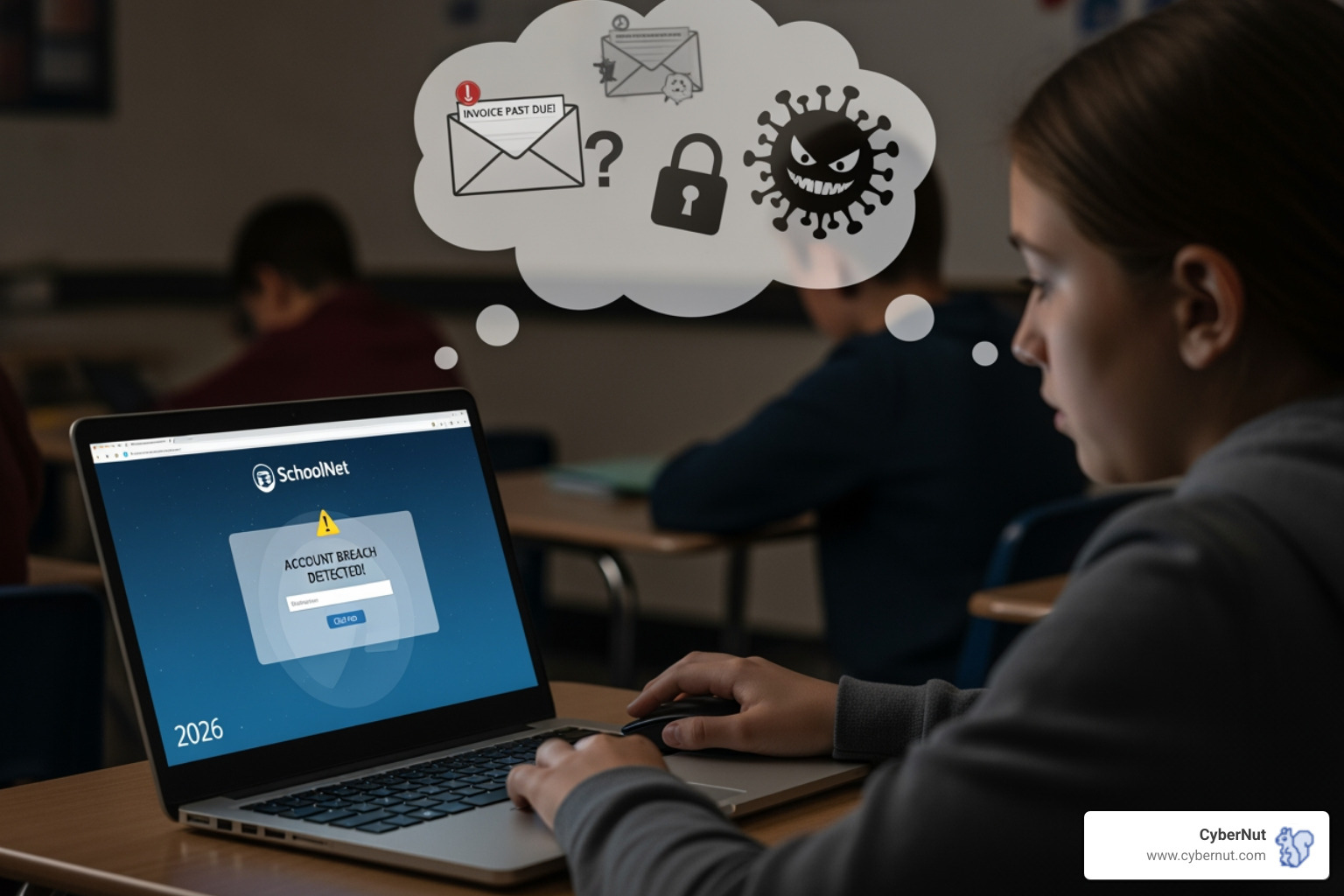
While email remains a primary attack vector, criminals are diversifying their methods. For 2026, we predict a major increase in multi-vector attacks that bypass traditional email filters.
One fast-growing method is QR code phishing ("Quishing"). Cybercriminals embed malicious links in QR codes and distribute them on physical flyers or official-looking notices. These codes can redirect users to fake websites designed to steal login credentials. Microsoft Defender for Office 365 reports that "approximately more than 15,000 messages with malicious QR codes are targeted toward the educational sector daily." This tactic is especially dangerous as it can compromise personal devices that may lack school-level security.
We also expect more smishing (SMS phishing) and vishing (voice phishing). Vishing attacks, in particular, saw a massive jump, increasing "by 449% in 2025." These methods exploit the trust people place in phone calls and texts, often using urgency to trick victims into divulging sensitive information.
Finally, compromised EdTech platforms and supply chain attacks are a growing concern. A single compromise in a student information system, cafeteria software, or other shared platform "can affect dozens of districts," creating a domino effect of vulnerability.
As phishing becomes more advanced, it also becomes more targeted. Attackers are shifting from generic, mass emails to highly personalized spear-phishing and whaling attacks designed to exploit specific roles within a school district.
Whaling attacks will focus on high-value targets like superintendents and finance staff. A perfectly crafted email appearing to be from the superintendent directing an urgent wire transfer is a prime example of Business Email Compromise (BEC). Spear-phishing will target other staff with custom lures, such as fake invoices for finance personnel or malicious job applications for HR. The education sector's high staff turnover rate, ranked "sixth highest compounded rate of change," makes it easier for attackers to exploit new employees who are less familiar with security protocols and more susceptible to social engineering.
K-12 schools are in the crosshairs of cybercriminals for a reason. They hold a treasure trove of valuable data but often face unique challenges that make them tempting targets. This combination creates a perfect storm for attacks, from simple scams to complex nation-state plots.
School IT environments often have gaps that attackers are adept at exploiting. Key vulnerabilities include small IT teams, tight budgets, and education software not built with robust security.
Many districts operate with limited IT budgets and small security teams, making it difficult to keep pace with evolving threats while managing thousands of devices. Furthermore, a reliance on older, legacy systems or a patchwork of different cloud applications can create hidden security weaknesses.
Schools also manage a large and transient user base—students, new teachers, substitutes, and parents—making consistent security training a monumental task. This is compounded by Bring-Your-Own-Device (BYOD) policies. While convenient, personal devices may lack the security of school-owned equipment and can become "easy pivots" for attackers to access the school network, especially through tactics like QR code phishing.
Finally, the open, collaborative culture essential for learning can make networks somewhat "porous." A trusting environment can make staff and students more susceptible to clever phishing and social engineering tactics.
To understand where your district is most vulnerable to the threats outlined in Phishing Trends 2026: Predictions for K–12 and How Schools Can Prepare Today, a professional assessment is crucial. Get a complimentary phishing audit to understand your district's unique vulnerabilities and baseline risk.
A successful phishing attack is not a minor tech glitch; it can be devastating for the entire school community.
First, there's the exposure of student data. Schools store vast amounts of private information, including health records and financial details. In 2024, "58% of all compromised data in the educational services vertical were personal data." A breach of this Personally Identifiable Information (PII) can lead to identity theft and significant privacy issues for families.
Next are the major financial losses. Ransomware, often initiated by phishing, can halt school operations by encrypting critical systems. The cost to recover from these attacks for K-12 schools more than doubled in 2024, with "financial impacts exceeding $1.2 million per incident!" This is money diverted from educational priorities.
Attacks can also force school closures, disrupting learning for days. Imagine losing access to student records, attendance, and grades. This happened to "67% of affected districts lost access to student records for 5+ days," impacting everything from daily operations to special education services.
Finally, a breach causes huge damage to a school's reputation and erodes community trust, potentially affecting enrollment. It also leads to a long-term financial sting through increased insurance premiums, with hikes "by as much as 150% for districts with previous incidents," further straining tight budgets.
Facing the sophisticated threats of Phishing Trends 2026: Predictions for K–12 and How Schools Can Prepare Today can feel daunting, but K-12 schools are far from defenseless. By taking proactive steps with smart technology and a clear response plan, districts can build a strong digital shield. It’s about preparing now, not waiting for an incident.
Effective cybersecurity requires multiple layers of protection, as no single tool can stop every threat. A strong defense combines different technologies to create multiple barriers against phishing.
To understand where your technological defenses can be improved, a thorough assessment is key. Get a complimentary phishing audit to find your unique weaknesses and map out a clear path forward.
Even with the best defenses, an attack can still slip through. A clear, tested Incident Response (IR) plan is therefore essential. It's not a matter of if an attack will happen, but when. A solid IR plan helps you contain the damage, recover quickly, and protect your school community.
A great IR plan for a K-12 school should include:
You can deploy every cutting-edge security tool, but if your people aren't engaged, you remain vulnerable. Technology provides essential barriers, but the human firewall—the collective awareness of your entire school community—is what truly makes the difference. Cybersecurity isn't just an IT problem; it's everyone's responsibility. When a teacher pauses before clicking a suspicious link or a student questions an odd message, attacks are stopped in their tracks.
Traditional, once-a-year security training doesn't work. The information is forgotten long before a real phishing attempt arrives. To combat the threats of Phishing Trends 2026: Predictions for K–12 and How Schools Can Prepare Today, we need a modern, continuous approach.
Ongoing training is the foundation. Cybersecurity must be a regular conversation, not an annual checkbox. The key is to respect people's time with micro-learning modules—bite-sized lessons that take just a few minutes but deliver high-impact knowledge that fits into busy schedules.
Gamification transforms training from a chore into an engaging activity. Quizzes, leaderboards, and interactive scenarios make learning memorable and effective. When training feels like a game, people are more likely to participate and retain the information.
Simulated phishing tests provide a safe way to gauge awareness. Sending realistic but harmless phishing emails helps identify who needs more support without real-world consequences. These tests should be used as teaching moments, not punitive measures. When someone clicks, it's an opportunity to reinforce learning.
Finally, role-specific content is crucial. A kindergarten teacher, a finance director, and a student face different threats and need custom training. Students need foundational digital literacy, staff need hands-on exercises relevant to their roles, and parents need guidance on supporting safe practices at home. Customizing content makes it relevant and actionable for everyone.
Training alone is not enough; the goal is a cultural shift where security awareness becomes second nature. The biggest barrier is often fear of blame. If people worry about getting in trouble for reporting a false alarm, they won't report anything.
Encouraging reporting without blame is critical. Staff and students must feel safe asking, "Is this suspicious?" A simple "See Something, Say Something" policy empowers everyone to be an active defender. This allows IT to investigate potential threats before they become breaches.
Timing is also important. Integrating security into onboarding for new staff and students is essential, especially given the high turnover rates in education. New employees are prime targets for attackers, so making security part of the welcome process closes a key window of vulnerability.
This cultural shift starts at the top. Making cybersecurity a district-wide priority requires leadership buy-in. When superintendents and principals champion security, allocate budget for it, and model good practices, it becomes part of the institutional culture.
Building this human firewall is a powerful investment in your people. Unlike hardware that becomes obsolete, a security-conscious culture only grows stronger. If you're wondering where your district currently stands, get a complimentary phishing audit to see where the gaps are and what your team needs most.
Protecting students from the threats of Phishing Trends 2026: Predictions for K–12 and How Schools Can Prepare Today requires a multi-layered approach. Students' digital curiosity can make them targets, so protection must be age-appropriate.
Start with foundational digital literacy, teaching the basics of online safety and privacy from an early age—a digital version of "stranger danger." Encourage them to question suspicious messages and understand that if an offer seems too good to be true, it probably is.
These lessons must be supported by strong technical controls. This includes robust content filtering and safe browsing environments on all school-issued devices. While only 5% of students currently have multi-factor authentication (MFA), expanding its use on student accounts adds a powerful layer of defense. The goal is to empower students with knowledge while safeguarding their digital environment.
Limited budgets are a reality for most K-12 schools, but some of the most impactful security measures are also the most cost-effective.
Your top priority should be implementing Multi-Factor Authentication (MFA). It is the single most effective action you can take. An account with MFA is 99.9% less likely to be compromised, and many existing platforms offer it as a free, built-in feature. Turn it on for all staff and student accounts.
Next, invest in regular security awareness training. A well-trained "human firewall" is your best defense against phishing. Automated micro-trainings are a cost-effective way to deliver engaging lessons that prevent costly breaches.
Finally, ensure all systems are consistently patched and updated. Software updates often contain critical security fixes that close vulnerabilities attackers exploit. This fundamental step costs little but provides significant protection. To prioritize your efforts, get a complimentary phishing audit to identify your most pressing vulnerabilities.
Getting buy-in from busy teachers and staff requires making training engaging, brief, and directly relevant to their work and their students' safety.
Replace long, boring presentations with concise, interactive 'micro-learning modules' that respect their time. Use real-world examples of cyber incidents at other schools to make the threat feel personal and urgent. When staff see how a single click can lead to school closures or data breaches, the importance of vigilance becomes clear.
Frame cybersecurity as a critical part of protecting students and ensuring an uninterrupted learning environment. When teachers understand that spotting a phishing email keeps their classroom running, they are far more likely to engage. Using gamification can also make the training more memorable and even fun. When security is a shared mission, everyone wins.
As we've explored the upcoming Phishing Trends 2026: Predictions for K–12 and How Schools Can Prepare Today, it's clear that the digital landscape for our schools is changing rapidly. The threat of advanced phishing isn't some far-off problem; it's an immediate and evolving reality that requires our attention today.
It might feel a bit overwhelming, but here's the good news: your school isn't powerless. While cutting-edge technology acts as a vital shield, the strongest defense you have is actually your people. Imagine a school where every staff member, student, and parent is part of a vigilant community – a true human firewall.
By blending robust technical controls with a culture of security built through smart, engaging training, schools can confidently steer the challenges of 2026 and beyond. This combined approach is what creates genuine resilience in the face of increasingly sophisticated cyberattacks.
That's exactly where CyberNut steps in. We specialize in empowering your community, turning everyone into a proactive defender through automated, gamified micro-trainings designed specifically for the unique K-12 environment. We help build that "human firewall" that stands strong against the digital tide.
Ready to see how strong your school's defenses are right now? We invite you to get a complimentary phishing audit to pinpoint your district's specific vulnerabilities and risks. And to truly empower your team, explore CyberNut's training platform – because a well-trained community is your best defense.
Oliver Page
Some more Insights


Back
.png)
.png)

.png)
.png)
.png)
.png)