Oliver Page
Case study
December 1, 2025
All About NJ's Data Breach Notification Law: Implications for School Districts is a critical topic for 2025. New Jersey has enacted two key laws that change how school districts handle student data: the NJ Data Breach Notification Law (N.J. Stat. § 56:8-163) and the new Student Data Privacy Law (S332), effective January 15, 2025.
Quick Answer: Key Requirements for NJ School Districts
The stakes are high. K-12 schools are second only to healthcare in data breaches, with over 1,600 incidents in US public schools from 2016-2022. Cybercriminals target schools for their valuable data, while IT departments are often understaffed. This guide breaks down both laws, clarifies your obligations, and provides a compliance roadmap. It will show how proactive cybersecurity training can transform your staff into your strongest defense your human firewall.
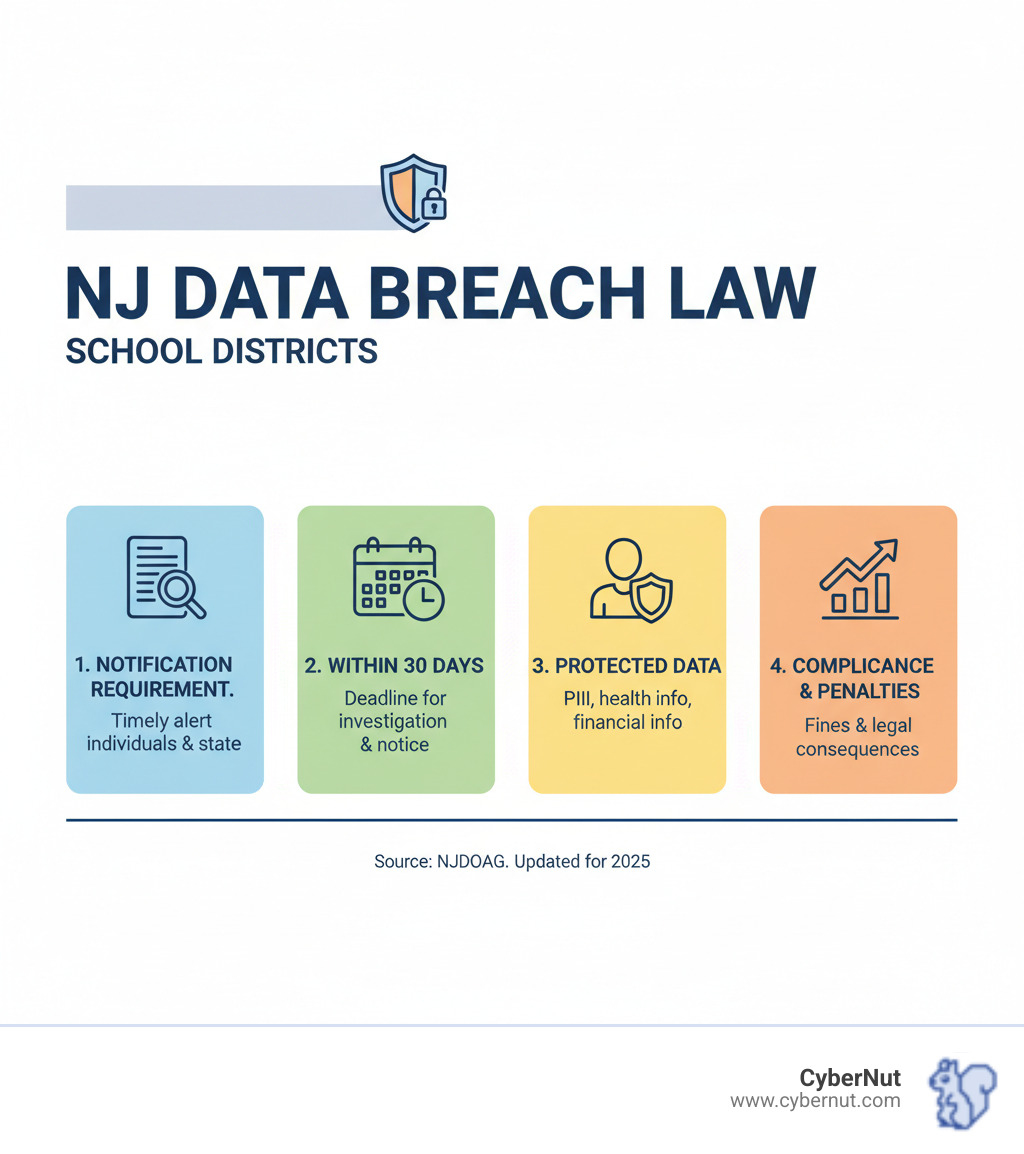

Understanding All About NJ's Data Breach Notification Law: Implications for School Districts means knowing the two key laws protecting student data.
Enacted in 2005, this law requires any organization with computerized records of NJ residents to notify them of a data compromise. The goal is to prevent identity theft.
"Personal information" is defined as a name paired with a sensitive identifier like a Social Security number, driver's license number, or an account number with security codes. Amendments expanded this to include a username or email address combined with a password or security question.
A "breach of security" is the unauthorized access to electronic files containing this personal information. If the data was properly encrypted and the key was not compromised, it is generally not considered a notifiable breach.
Upon a breach, you must first report to the New Jersey Division of State Police before notifying affected residents. This allows law enforcement to investigate.
Effective January 15, 2025, Senate Bill 332 (S332) provides comprehensive, student-focused protections that go beyond breach notification. It regulates how schools and vendors collect, use, and store student data.
S332 applies to organizations processing data from 100,000 or more NJ students annually, or 25,000 students if the organization derives over 50% of its revenue from selling personal data.
Your school district is typically a data controller, deciding how student data is processed. An ed-tech vendor is a data processor, handling data on your behalf. Both have responsibilities and face penalties under S332. The law grants new rights to students and parents, restricts data use for advertising, and requires detailed vendor contracts. To learn more about student-specific protections, see our guide on What to know about New Jersey's Student Online Privacy Protection Act (SOPPA NJ).
This section outlines the practical steps for All About NJ's Data Breach Notification Law: Implications for School Districts, combining requirements from both the general law and the NJDPA (S332).
Under the NJDPA (S332), protected data is extensive. Personally Identifiable Information (PII) includes a student's name combined with a Social Security number, driver's license, or financial account info. It also covers online credentials like a username/email with a password.
Sensitive Data receives even stronger protection and includes information on race, religion, health diagnoses, sexual orientation, citizenship, biometric data, and precise geolocation. For a full list, see our guide on Sensitive Data Definition and Types.
A notification is triggered by unauthorized access to electronic files containing personal information. This can be a hack, an employee error, or a lost device. If the data was encrypted and the key is secure, you may not need to notify individuals, but you must document the incident.
Vendor breaches are also your responsibility. The NJDOE requires vendors to report breaches of PII to them within 24 hours. Your own notification clock starts when you are informed, making strong vendor contracts essential.
When a breach occurs, follow a clear plan:
The NJDPA (S332) is enforced by the NJ Attorney General's Division of Consumer Affairs. Penalties are up to $10,000 per violation for a first offense and $20,000 per violation for subsequent ones. For the first 18 months (until July 2026), organizations have a 30-day cure period to fix violations before penalties are issued. There is no private right of action; complaints go through the Attorney General.
While FERPA is the federal baseline, the NJDPA provides stronger protections. Here’s a quick comparison:
FERPA compliance is necessary but not sufficient. For more on FERPA, read our guide: All About FERPA: The Federal Student Privacy Law That Still Matters in 2025.

Implementing All About NJ's Data Breach Notification Law: Implications for School Districts requires an ongoing commitment to security. Here’s a step-by-step guide.
Cybercriminals see schools as soft targets. Your defense must include both technical safeguards and an educated workforce.
Technical Measures:
Human-Centered Measures:Research shows that 68% of data breaches involve human error. Your staff can be your weakest link or your strongest defense. Building a human firewall is critical.
Assess your current vulnerability with a complimentary phishing audit.
Compliance is an ongoing process. Stay on track with these steps:
Here are answers to common questions about New Jersey's student data laws.
While FERPA sets a federal baseline, the NJDPA (S332) provides broader and stricter protections. Key differences include:
Essentially, FERPA compliance is no longer enough for NJ schools. For a deeper dive, see our guide: All About FERPA: The Federal Student Privacy Law That Still Matters in 2025.
If a vendor has a breach involving your students' data, you must act quickly. Your vendor contract should require them to notify you within 24 hours.
Your immediate steps should be:
No, not without obtaining explicit, affirmative consent. The NJDPA (S332) has very strict rules against these practices.
The law's definition of "sale" is broad, including the exchange of personal data for "other valuable consideration." This means providing free software in exchange for student data could be considered a sale.
Targeted advertising is also prohibited without consent. The consent requirements are age-based: students aged 13-16 can consent themselves, while parental consent is mandatory for children under 13. The bottom line is that student data should only be used for educational purposes.

The digital landscape offers tremendous opportunities, but it also brings new responsibilities. With the NJ Data Breach Notification Law and the NJ Data Privacy Act (S332) now in effect, understanding All About NJ's Data Breach Notification Law: Implications for School Districts is a critical duty.
Compliance is about more than avoiding fines of up to $20,000 per violation; it's about upholding the trust your community places in you to protect student data. It's about ensuring a safe learning environment where privacy is respected.
The path forward is clear: proactive cybersecurity is your strongest defense. Since 68% of breaches involve human error, your staff can be either your greatest vulnerability or your most powerful protection. With the right training, they become your human firewall.
CyberNut specializes in cybersecurity training designed for K-12 schools. We offer automated, gamified micro-trainings that build real phishing awareness and create a lasting culture of security. Our low-touch, engaging platform transforms your staff into vigilant defenders of student data without adding to your administrative burden.
Don't wait for a breach to expose your vulnerabilities. Take the first step today by getting a clear picture of your current risk. Find out how prepared your team is with a complimentary phishing audit. This free assessment provides actionable insights to strengthen your defenses immediately.
Ready to build a resilient cybersecurity culture? Explore our full suite of cybersecurity resources and let us help you steer New Jersey's data privacy laws with confidence.
Oliver Page
Some more Insights


Back
.png)
.png)

.png)
.png)
.png)
.png)